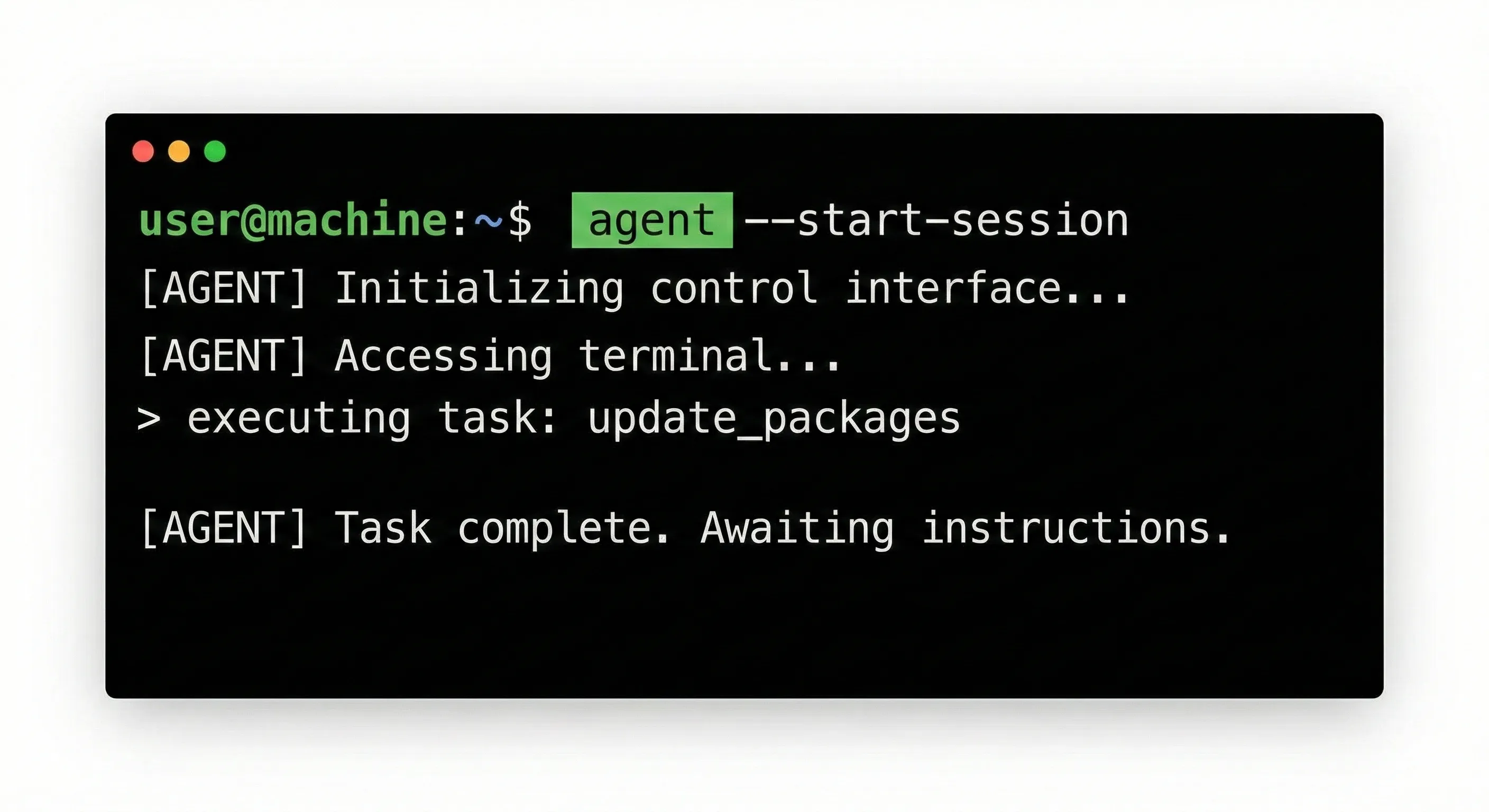
Why AI Agents Will Replace Chatbots: The Shift from Text to Action
The Problem with "Chat"
We've been trained to think of AI as a conversation partner. You ask a question, it responds. You refine the question, it refines the answer. This back-and-forth feels natural, but it's fundamentally limiting.
Here's the issue: chatbots are reactive. They wait for you. They can't browse, execute code, search your filesystem, or chain multiple steps together without you manually prompting each one.
Agents are different.
What Makes an Agent
An agent isn't just an AI with more tools. It's an AI with a loop. The difference is architectural:
| Chatbot | Agent |
|---|---|
| Responds once per prompt | Runs until the task is done |
| You chain the steps | It chains its own steps |
| "Here's the code..." | Writes, runs, debugs the code |
| Explains solutions | Implements solutions |
An agent can observe an outcome, decide it didn't work, try a different approach, and keep iterating. All without you typing another message.
A Real Example
Yesterday, I asked my agent to "set up Redis caching for my API."
A chatbot would give me a tutorial. Maybe 15 steps. I'd copy-paste, hit an error, ask again, adjust, repeat.
The agent:
- Checked my
package.jsonfor existing dependencies - Installed
ioredis - Created a
lib/redis.tsutility - Updated my API route to use caching
- Ran the dev server and tested the endpoint
- Fixed a connection error it found
- Reported back: "Done. Your
/api/dataendpoint now caches responses for 60 seconds."
Seven steps. Zero prompts from me.
Why This Matters for Developers
The shift from chatbots to agents isn't about convenience. It's about leverage.
When I'm in flow, the last thing I want is to context-switch between my editor and a chat window, formatting prompts and pasting code blocks. An agent lives inside my workflow. It sees my files, my terminal, my errors. It doesn't need me to explain the context because it reads it.
The Trade-off: Trust
Agents require trust. You're giving an AI permission to modify files, run commands, and make decisions on your behalf. That's a different relationship than a chatbot.
This is why observability matters. The best agent frameworks let you see every step, every tool call, every decision. You're not blind, you're supervising.
The Future Isn't Chat
I'm not saying chatbots will disappear. They're still perfect for brainstorming, explanations, and quick questions. But for work, for getting things done, agents are the better model.
The question isn't "What should I do?" anymore. It's "What do you want done?"
That's the shift. And it's happening now.

